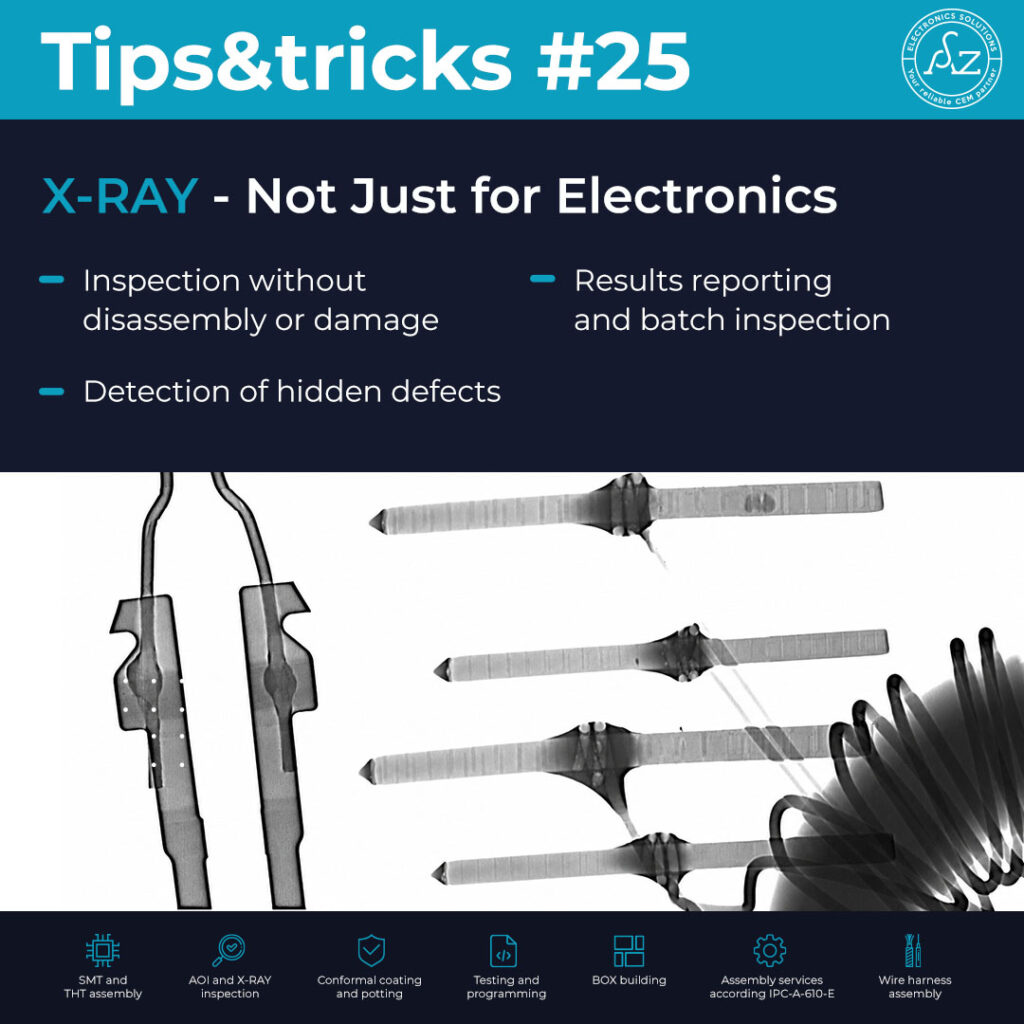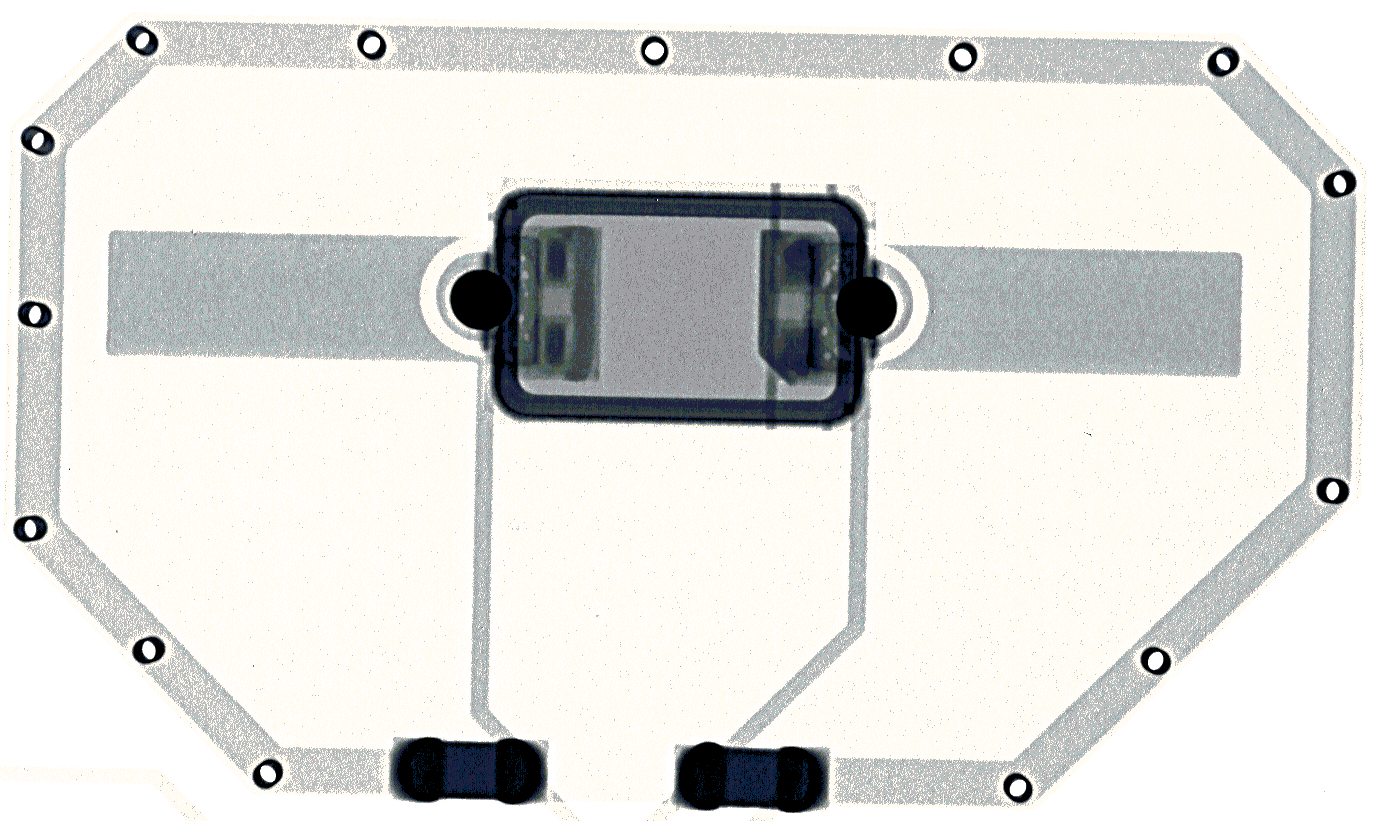
Thanks to X-RAY inspection, we can look inside a product without cutting, disassembling, or damaging it. X-RAY is one of the NDT (Non-Destructive Testing) methods. At ASZ Electronics Solutions, we use X-RAY equipment to inspect components, subassemblies, and finished products. It allows us to assess their internal structure, material integrity, and assembly quality, as well as detect irregularities that are not visible during standard visual inspection.
X-RAY inspection in electronics
We use the X-eye 5100F on a daily basis to inspect areas that are inaccessible to standard optical inspection. We check, among others, BGA and QFN packages, thermal pads, connectors, hidden solder joints, and structures located inside PCB laminates. This allows us to assess connection quality and detect voids, component misalignment, and other assembly defects.
External non-destructive testing services
The capabilities of our equipment go beyond electronics inspection. We also provide X-RAY inspection services for industrial companies, automotive companies, quality departments, laboratories, component suppliers, and companies involved in product inspection.
We can inspect internal connections, the arrangement of wires and components, cracks, voids, material discontinuities, as well as the correctness of assembly and the relative positioning of parts. We support finished-product inspection, verification of supplied parts, complaint analysis, and assessment of potential causes of failures.
The inspection scope is adapted to the type of product and the purpose of the test. We can inspect individual samples, selected items from a batch, or larger production series. Since the inspection does not require any interference with the product structure, the inspected item can be used for further testing, operation, or the next production stage.
Key benefits of X-RAY inspection:
- fast identification of potential defects,
- inspection of the inside of a finished product without damaging it,
- assessment of internal structure, material integrity, and assembly quality,
- photographic documentation confirming the performed inspection,
- possibility to inspect individual samples as well as larger batches,
- support in complaint handling, audits, and failure analysis,
- reduction of the risk of unplanned failures and related costs,
- possibility to prepare an inspection report,
- preparation of consolidated reports for consecutive production series, including the number and percentage of OK and NOK items, types of detected non-conformities, batch results, and quality trends over time.