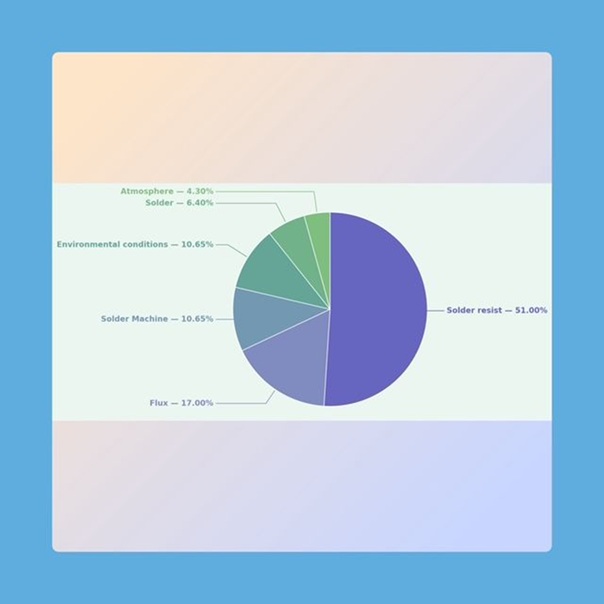
Solder mask issues can account for up to 10–15% of PCB defects.
Most common causes:
➡ Insufficient UV exposure or incorrect curing profile
➡ Low-quality materials
➡ Lack of validation for soldering process compatibility
🎨 Color matters more than you think Solder mask color directly affects curing behavior. Green masks are relatively easy to cure, while black, blue, or purple masks require adjusted exposure settings due to higher pigment density and light absorption. Using identical process parameters for all colors significantly increases the risk of under-curing and defects.
🔥 What happens during reflow? Most PCB manufacturers test solder mask resistance to chemical processes – but not always to soldering conditions. During reflow, hidden issues may become visible: • Solder balls • Delamination • Local mask chipping
🚀 High-reliability applications Some solder masks (e.g., Taiyo PSR-4000, Sun Chemical products) meet ECSS-Q-ST-70-02 and ASTM E595 (NASA outgassing standard) requirements: ✔ TML < 1% ✔ CVCM < 0.1% This is critical for: • Space electronics • Optical systems (cameras, detectors) • Vacuum environments
🧪 Quick check before production The pencil hardness test cannot replace full qualification, but it can serve as a fast, practical indicator of solder mask curing quality before production launch.
🔗 List of low outgassing materials: https://lnkd.in/dn45NSrx
💡 In practice, solder mask-related issues often become visible only at the assembly stage – not during standard PCB incoming inspection.